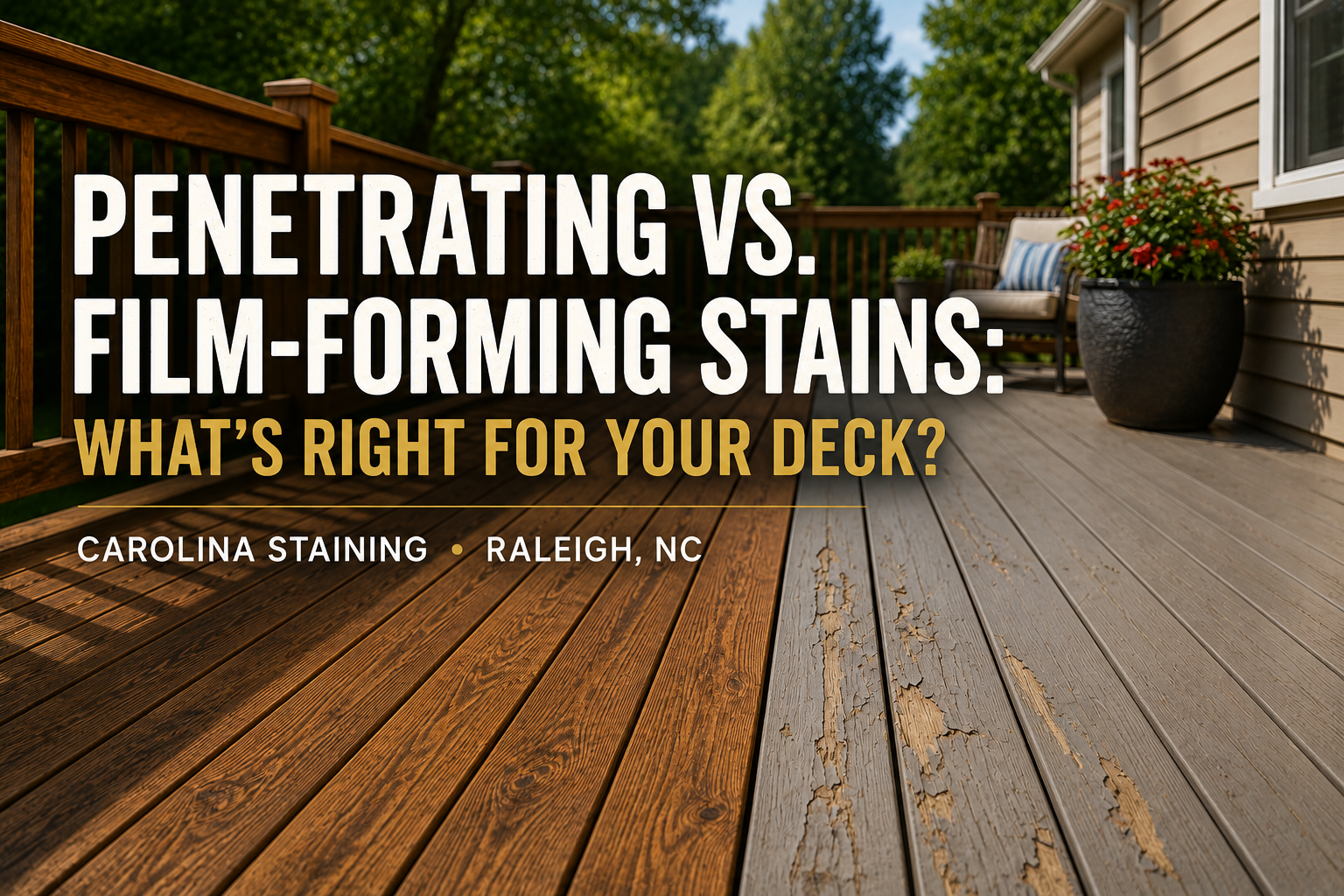
Walk into any big-box store and you'll find an entire aisle of deck stains — solid colors, semi-transparent, oil-based, water-based, "maximum protection," "lifetime guarantee." It's a lot. But underneath all the marketing, every deck stain on that shelf falls into one of two categories: it either soaks into your wood, or it sits on top of it. That single difference determines almost everything about how your deck looks, how long the finish lasts, and how much work you'll do every few years to maintain it.
In North Carolina — where decks face a relentless combination of summer UV, high humidity, and heavy afternoon rain — the wrong stain type doesn't just underperform. It fails visibly, often within a season, and leaves you with a worse starting point for the next coat. Most of the peeling, flaking decks we get called to fix were stained with a product that simply wasn't compatible with the wood underneath it.
Here's how to understand the difference, and what we recommend for the pressure-treated pine decks that make up the majority of homes in the Raleigh area.
A penetrating stain — also called a transparent or semi-transparent stain — is designed to absorb into the wood fibers rather than coat the surface. When applied correctly, the stain carries its pigment and protective resins down into the wood itself, where it becomes part of the board rather than a layer sitting on top of it.
Because there's no film on the surface, there's nothing to peel, crack, or blister. The finish wears out by gradually fading and eroding, the same way the wood weathers naturally. When it's time to reapply, you clean the deck, let it dry, and put on a fresh coat — no stripping, no sanding down old layers, no fighting with flaking paint. That ease of maintenance is one of the biggest practical advantages for homeowners who plan to stay in their house long term.
Penetrating stains are almost always oil-based or oil-modified, which matters for performance in the Southeast. Oil-based formulas soak deeper into the wood grain than water-based products, provide stronger mildew resistance, and are better at replenishing the natural oils that pressure-treated and weathered pine lose over time. The tradeoff is a longer drying time and a stronger odor during application — neither of which is a dealbreaker when you're doing the job once every 2–3 years.
A film-forming stain creates a surface coating on top of the wood — think of it as a thin layer of heavily pigmented paint. Solid stains, semi-solid stains, and most of the "deck resurfacing" products you'll see advertised are film-forming products. They can look sharp on day one: vivid color, uniform finish, no visible grain variation.
The problem is what happens next. Wood expands and contracts with every change in temperature and moisture — and in a climate like North Carolina's, those changes are constant. The film sitting on top of the wood moves differently than the wood beneath it. Over time, usually 1–2 seasons on a horizontal deck surface, that mechanical stress causes the coating to crack and lift. Once water gets underneath the film, the bond breaks and peeling begins. At that point, your only path forward is stripping the entire deck down to bare wood before you can apply anything new.
Film-forming stains have a specific problem with pressure-treated wood in particular. The copper-based preservatives used in the treatment process interfere with the chemical bonding that film-forming products rely on. Independent testing has documented peeling in as little as 12–18 months on treated pine decks that received a solid acrylic stain — even when applied correctly. This is not a DIY error; it's a chemistry mismatch.
That said, film-forming products aren't always the wrong choice. They make sense for vertical surfaces like fences and siding where wood movement is less dramatic, for covering heavily weathered or gray wood where you want to hide damage rather than reveal grain, and for situations where a specific solid color is a priority for design reasons.
Side-by-Side Comparison
| Feature | Penetrating | Film-Forming |
|---|---|---|
| How it works | Soaks into the wood | Sits on top of the wood |
| Appearance | Natural wood grain shows | Solid or semi-solid color |
| Peeling risk | Low — wears gradually | Higher — can peel & crack |
| Reapplication | Easier — no stripping needed | Requires stripping old finish |
| Best for NC climate | Yes | Situational |
For deck surfaces in the Raleigh, Clayton, and Johnston County area — the vast majority of which are built with pressure-treated pine — we recommend a penetrating semi-transparent stain in nearly every situation. The combination of NC humidity, high UV exposure, and the natural density of treated pine makes it the most reliable product category by a significant margin.
Specifically, we look for oil-based penetrating formulas with built-in mildew inhibitors. In our climate, mildew resistance isn't optional — decks here, especially partially shaded ones, will show mildew growth within a season without it. A stain that contains an EPA-registered mildewcide actively works against that rather than just slowing it down.
For new pressure-treated decks, there's one additional factor: timing. Freshly treated pine is saturated with moisture from the treatment process, and stain simply will not absorb into wet wood properly. The standard guidance is to wait 3–6 months before applying any stain, and to confirm readiness with a water test — sprinkle a few drops on the surface, and if they bead up rather than absorbing, the wood isn't ready yet.
If you have an older deck that's already been coated with a film-forming product and it's beginning to peel, we can assess whether the wood underneath is still sound and what the correct prep and recoating process looks like. The answer depends on how far along the failure is and what the wood condition is — it's not one-size-fits-all, which is exactly why we offer free on-site estimates.
Choosing a stain type isn't glamorous, but it's the decision that determines everything that comes after it — how long the finish lasts, how hard the next recoat will be, and whether you're protecting your deck or just painting over a problem. If you're not sure which category applies to your situation, that's exactly the kind of question we're built to answer. Give us a call or text and we'll take a look.