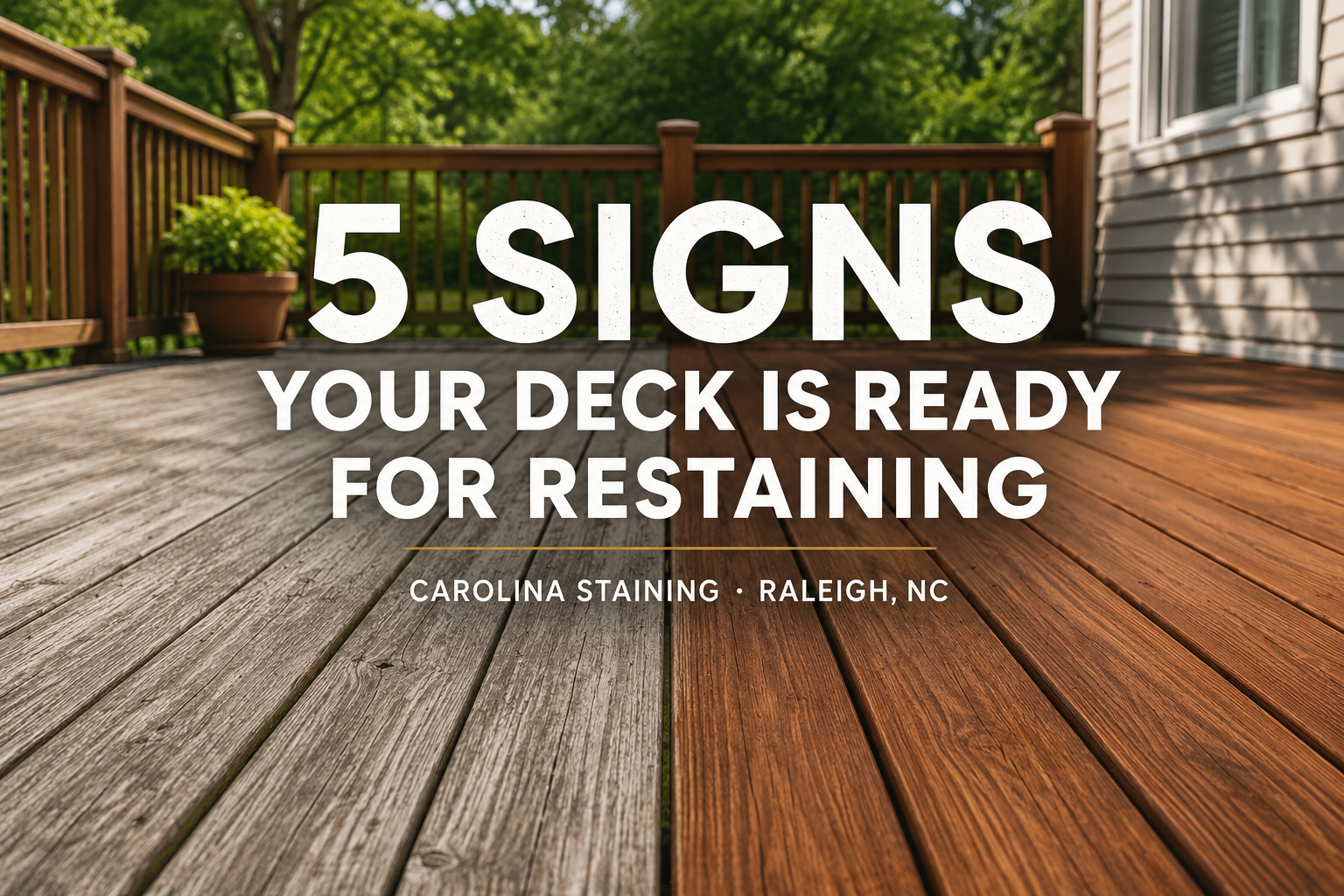
If you live in the Raleigh area, your deck takes a beating year-round. Between the summer heat, high humidity, afternoon thunderstorms, and the occasional winter freeze, North Carolina is one of the harder climates on outdoor wood in the country. Most pressure-treated pine decks — which make up the vast majority of decks in Clayton, Garner, Smithfield, and the surrounding communities — need to be restained every two to three years to stay protected and looking their best.
The problem is most homeowners wait too long. By the time a deck looks obviously bad, the wood has usually been unprotected for a full season or more — and the damage starts to compound. A little gray and weathering is cosmetic. Cracking, splitting, and soft spots are structural, and those repairs cost significantly more than a timely restain.
Here are the five signs we look for when we assess a deck. If your deck is showing even two or three of these, it's time to act before the next season makes it worse.
1. The Wood Has Turned Gray or Silver
This is the most visible sign, and one of the most misunderstood. That silver-gray color isn't just cosmetic — it's the result of UV rays breaking down the lignin in the wood fibers. Lignin is what holds wood together structurally. Once it starts breaking down on the surface, the wood becomes more porous, absorbs more moisture, and begins to degrade faster.
Freshly stained wood should have a warm, consistent tone — whether natural, amber, or tinted. If yours has gone flat and gray, the protective finish is gone and the wood is working against the elements unprotected.
The good news: graying alone doesn't mean the wood is damaged beyond repair. A proper cleaning with a wood brightener (oxalic acid) and a fresh penetrating stain can restore the color and more importantly, the protection. We see this on the vast majority of decks we service in the Raleigh area — and it's one of the most satisfying transformations we do.
2. The Finish Is Peeling or Flaking
Peeling is a tell-tale sign that a film-forming stain or paint was used on the deck at some point. Film-forming products sit on top of the wood rather than soaking into it, and over time — especially in a humid climate like ours — moisture gets underneath and causes the coating to bubble, crack, and peel.
This is a more involved situation to fix because the old coating has to be fully stripped before anything new can be applied. Staining over peeling finish is one of the most common mistakes homeowners make, and it guarantees the new coat will fail just as fast. The stripping process takes extra time and product, but it's non-negotiable if you want the new stain to penetrate and bond properly.
If your deck is peeling, don't panic — but don't ignore it either. Every season you wait, more moisture gets into the exposed wood. Peeling typically gets worse fast in North Carolina's summer rain cycle.
3. The Water Bead Test Fails
This is the quickest and most reliable test you can do yourself right now — no tools required. Take a glass of water and pour a small amount onto the deck boards. Watch what happens in the first 10 seconds.
- Water beads up and rolls off — your stain is still doing its job. You're in good shape.
- Water soaks in slowly — the finish is wearing thin. Plan for a restain in the next few months.
- Water soaks in immediately and darkens the wood — the protective barrier is gone. The wood is drinking in whatever hits it, including mold spores, dirt, and humidity. Restain as soon as conditions allow.
A good penetrating stain works by sealing the wood pores from within. When that seal is gone, water absorption accelerates the entire decay process. The water bead test takes 30 seconds and tells you more than looking at the deck ever will. We recommend homeowners do this test once a year, ideally each spring before the rainy season picks up.
4. The Wood Feels Rough, Cracked, or Splintered
Run your hand across the deck boards — or better yet, walk across them barefoot. Healthy, well-maintained wood should feel relatively smooth. If you're catching on raised grain, small cracks, or actual splinters, the wood fibers on the surface have dried out and started to separate.
This happens when wood goes through repeated wet-dry cycles without a protective barrier in place. Rain soaks in, the sun dries it out, the wood expands and contracts — and over time the surface starts to check and crack. In North Carolina, we see this happen faster than in drier climates because the humidity cycles are so dramatic season to season.
Surface roughness and light cracking are still very repairable with proper prep and a quality penetrating stain. Deep cracks that go through the board, or boards that feel soft and spongy underfoot, may indicate rot — which is a structural issue that needs to be addressed before staining makes sense. When we do free estimates, we always check for this and will tell you honestly if any boards need replacing first.
5. It Has Been More Than 2 to 3 Years Since the Last Stain
Even if your deck looks decent on the surface, time alone is a reason to schedule an inspection. In most parts of the country, a quality penetrating stain lasts three to four years. In North Carolina, we tell people to plan for two to three — sometimes less on decks with heavy sun exposure or those under large trees that hold moisture.
Our climate is hard on outdoor wood. Summers are hot and humid. Afternoon rain is frequent from May through September. Winters bring freeze-thaw cycles that stress wood joints and end grain. All of that adds up, and most of the damage happens gradually — which means you won't always see it coming until a board pops or a section goes soft.
The most cost-effective approach to deck ownership is a consistent maintenance schedule. A restain every two to three years typically runs a few hundred to around a thousand dollars depending on the size and condition of the deck. Replacing a deck that's been neglected runs several thousand. We've seen both scenarios, and the math is always the same — maintenance wins.
What to Do If Your Deck Is Showing These Signs
If you checked off two or more of these signs, the right move is to get an estimate before the damage gets worse. A professional assessment is free, takes about 20 minutes, and gives you a clear picture of what your deck actually needs — whether that's a straightforward restain, a full prep-and-stain service, or in rare cases, some board replacement first.
At Carolina Staining, we specialize exclusively in deck and fence staining. We're not a general handyman service that does staining on the side — this is the only thing we do, which means we're faster at diagnosing problems, more consistent in our results, and better equipped to match the right product to your specific wood type and condition.
We serve Raleigh, Clayton, Garner, Smithfield, Fuquay-Varina, Holly Springs, and the surrounding communities throughout Johnston and Wake Counties. Call or text us at 919-588-2925 and we can usually get out to you within the week for a free, no-pressure estimate.